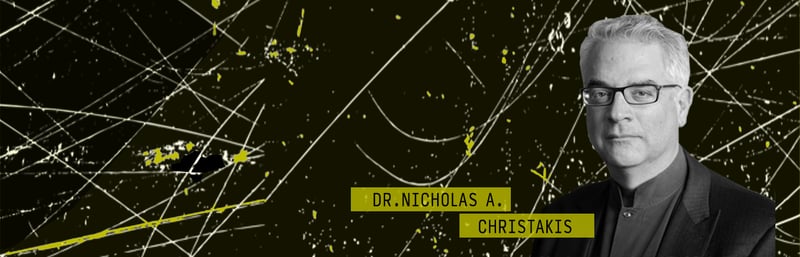
FCAT hosts an ongoing Speaker Series as part of its mission to “bring the outside in” and share diverse perspectives with Fidelity associates that provoke conversation. A few weeks ago, as part of that series, the FCAT Research team hosted a presentation by Dr. Nicolas Christakis, author of Apollo’s Arrow – The Profound and Enduring Impact of Coronavirus on The Way We Live. Dr. Christakis is a physician and sociologist who explores the ancient origins and modern implications of human nature. He directs the Human Nature Lab at Yale University, where he is the Sterling Professor of Social and Natural Science in the Departments of Sociology, Medicine, Ecology and Evolutionary Biology, Statistics and Data Science, and Biomedical Engineering. He is the co-director of the Yale Institute for Network Science, the coauthor of Connected, and the author of the New York Times best seller Blueprint. After his presentation, we had a chance to ask Dr. Christakis a few more questions prompted by his talk, his book, and his work.
FCAT: Can you look at the 1918 pandemic and its aftermath and make any comparisons to the COVID-19 pandemic? For example, did people begin to move out of Philadelphia, which was particularly hard hit? Did family formation stall in the wake of the pandemic? What were the economic impacts?
Dr. CHRISTAKIS: Well, analyzing the 1918 pandemic in the USA is difficult because, of course, we had just come out of World War I. So, with respect to family formation, there were a lot of other changes in our society, from the winnowing out of a whole generation of young men, including changes in marital behavior because of the relative imbalance between marriage-age men and women. So, it's very difficult to disarticulate the impact of the pandemic from the impact of the first world war.
However, I can tell you that, in general and unsurprisingly, for thousands of years in times of pandemics – and now as well – people have fled the cities. That’s very typical, a flight to rural areas. So, I would suspect the same thing happened to some extent in 1918. But remember also back then we were a much more rural society. In my book, I have an example from the 18th century of a yellow fever epidemic in Philadelphia, which I think killed 10% of the residents of that city. People fled the city then too. I mean, cities have always, to my knowledge, been seen as very dangerous places to be in times of epidemic disease.
FCAT: You mentioned Sweden and their handling of the pandemic in your presentation. What is your point of view as to Sweden’s approach to the current pandemic?
Dr. CHRISTAKIS: I think there's a lot of misunderstanding about Sweden. I think Sweden has had one of the highest per capita death rates in Europe. Their economy has not been substantially protected. What did they gain from enduring that higher death rate? Did they somehow save their economy? No.
And if you compare Sweden to their neighbors like Denmark and Norway, they've done worse both economically and in terms of mortality. So, I don't see Sweden as some fantastic model that should be emulated. Back in March, the Brits and the Swedes both considered the idea of essentially saying: look, we cannot stop this virus, so let's just let it wash over us. It was not a crazy idea to consider. I mean, it’s not beyond the pale to put that on the table and examine the idea and see whether it's sensible or what the pros and cons might be in choosing this approach over some alternative. I was not one of those people who thought we should not even consider the idea. My view was let's consider it and decide what to do.
And the Swedes were not able to implement the idea in an optimal fashion. They were not able to protect their vulnerable elderly people, or in any case they didn't do so.
Furthermore, there have been a lot of arguments about semantics – like whether the Swedish government orders people to stay home or orders businesses to close. Well, even if the government doesn't order that, if the government says schools have to close and you can't have large gatherings and people have to wear masks and the people are scared and they don't go out, you get functionally the same outcome as a stay-at-home order, which is a collapse in business, regardless of what you do. And incidentally, this collapse in the economy is typical. I have examples in my book from thousands of years of epidemics where economies stood still.
FCAT: What is the typical cycle for these outbreaks? Are we looking at another possible outbreak within the next 20 years?
Dr. Christakis: In Apollo’s Arrow, I borrow from a paper written by Dr. Tony Fauci many years ago, looking at the instances of pandemics over the last 300 years. And the typical inter-pandemic spell is 10 to 20 years. So, we get a pandemic every 10 to 20 years. We had one, let’s remember, in 2009: the H1N1 pandemic. The reason many people don't remember it is that that the particular pathogen was not very deadly. It just caused the common cold basically. We don't remember it because it didn't kill many people when it spread around the world, but it may have affected many people.
But while we get a respiratory pandemic every 10 or 20 years, it's stochastic. And we don't get serious ones except for every 50 to 100 years. The last serious respiratory pandemic we had that was almost as serious as COVID-19 was in 1957. Just to remind readers, coronavirus is different than influenza. There are different species of virus. The last major respiratory pandemic, which was with an influenza virus, was the 1957 one. And before that, the most serious one was in 1918. And the coronavirus pandemic has surpassed, in terms of its severity, that 1957 pandemic. It's going to wind up being the second worst pandemic in a hundred years.
FCAT: You express your concern that it could kill as many as a million people and that it could also leave as many as 5 million people with after-effects, e.g. physical ailments caused by having the disease. Is that also typical of this type of virus? Does it leave a lasting mark?
Dr. Christakis: We don’t yet know the precise percentage that will be left with long-term disability. I do have a section in my book on the long-term disability implications of the 1918 pandemic. It is typical of serious viral respiratory infections to cause disability, whether pulmonary or other disability. Right now, the current estimates for coronavirus are roughly 5%, but candidly, we don't know the answer to that yet. And we won't know until time goes by. We know how lethal it is. But we will have to wait for the passage of time to be able to quantify the disability.
FCAT: How long must we wait to determine what the after-effects may be?
Dr. Christakis: I think within a couple of years, we'll have a sense of what fraction of people who had serious illness completely recover. Let's say a hundred people had symptomatic COVID-19. We know that about one out of a hundred or so will die. If they have very serious illness, if they're on a ventilator, maybe 20 out of a hundred will die. And then the remainder will survive.
For those with serious illness who survive, we could wait a year or two and test these 80 people and see that, for 75 of these 80, there's nothing wrong with them a year or two later. So, then we can be pretty sure we have an upper limit on the disability.
We know from long-term follow-up of the SARS-1 pandemic from 2003 that a significant fraction had long-term disability, to a greater or lesser extent – I want to say 15% of those people. These diseases do leave long-term impacts on our bodies.
FCAT: Last question. Will climate change contribute to the acceleration of these viruses?
Dr. Christakis: That's a very good question. In fact, along with Bill Nordhaus (a Nobel Laureate economist at Yale), I'm teaching a class in the spring at Yale on global catastrophes and looking at the coronavirus pandemic and climate change, which have a very similar economic structure, but a very dissimilar time horizon.
And in fact, these catastrophes of climate change and the pandemic are connected in a number of practical and conceptual ways. One of the practical ways they're connected is that, with climate change, there is migration of people and degradation of natural habitats, so that humans and animals come into contact more often. And all our current pandemics are zoonoses, which are diseases that afflict animals that move to humans. HIV, for instance, was a virus in monkeys before it came to human beings.
And so, humans and animals come into greater contact (in part, because of climate change). The animals come to our part of the world and we go to their part of the world. We have a greater probability of a leak of a pathogen. So yes, there is a connection with climate change. There was a study that I cite in the book from the journal Nature a few years ago that looks at new pathogens in humans. There were approximately 400 new pathogens in the last 30 years, and they were almost all from animals.
There are those practical connections, but there are a number of conceptual connections, too. One conceptual connection between climate change and the pandemic is that they both require science and taking science seriously. There are a number of ways in which these global catastrophes are connected, in fact. The idea that the virus is going to respect borders or that carbon dioxide is going to respect borders is ridiculous. They also require international cooperation to confront, right?
These connections might also facilitate our ability to work together, to take them seriously. Because if in fact the average person on the street now comes to see, “wait a minute, those scientists, they made a prediction about the epidemic and it was right. And I should have listened to them six months ago.” The thing about a pandemic is that the interval of time between the prediction and the outcome is so short, you can test the ability of the scientist to make a good prediction. Whereas with the climate change, you know, the scientists are saying in 50 years, something's going to happen. It's very hard to get people to take it seriously. But I think there may be an increased confidence in the ability of science and technology to help us address these types of collective threats.
References & Disclaimers
954174.1.0